The Cost of a Bad Hire in Ontario Construction (& the Fix Most Overlooked)


Published On
2023-08-17

Both career colleges and community colleges lead to rewarding careers, but their timelines, costs, and learning styles differ. Career colleges deliver hands-on training in six to twelve months, while community colleges offer broader two-year programs, helping you choose the right fit.
Life after high school can feel like a crossroads.
There are so many options available to you: university, a gap year, community college, career college, and entering the workforce right away. It's totally normal to feel overwhelmed as you weigh which career path is best for you.
In recent years, there’s been an uptick in students choosing between community college and career college as a pathway into the trades. Both public and career colleges can be great post-secondary options, but it's important to understand their similarities and differences before you enroll.
Here's what you need to know about career college vs. community college.
Career colleges are often referred to as "trade school," "vocational school," or "career colleges," depending on who you ask. In Ontario, career colleges are regulated under the Ontario Career Colleges Act, which sets standards for how these institutions operate and deliver training.
Career colleges strive to teach the practical skills students need to build careers for themselves in specific trades. Typically, students can expect predominantly hands-on training at a career college rather than sitting at a desk all day.
Career colleges often provide industry-specific training and certifications, and many programs are apprenticeships or pre-apprenticeships. This means you can make money while you learn a new skill.
A community college is a public post-secondary institution that offers a diverse range of programs for further education or career training. Community colleges usually award associate degrees or certificates upon completion.
The main difference between a community college and a university is that community college programs typically take two years to complete, whereas university programs take four years. Expect mostly traditional in-classroom learning at a community college, alongside labs for hands-on subjects.
While some community colleges do offer apprenticeship programs, they aren't the norm and shouldn't be an expectation when you enroll. Community colleges generally offer a broader range of academic and career pathways, including transfer credits to universities.
While career colleges and community colleges share a few commonalities, the key difference between them lies in specialization and flexibility.
Community colleges offer courses that build a general understanding of academic subjects such as math, science, literature, and law. They're a continuation of the school you’re used to, just at a higher level.
Career colleges skip most general classes and teach exact job skills instead. Popular programs at a trade school include plumbing, electrical, home renovation, and network cable technician training, though career colleges also prepare students for other in-demand fields, like healthcare and transportation, not just construction trades.
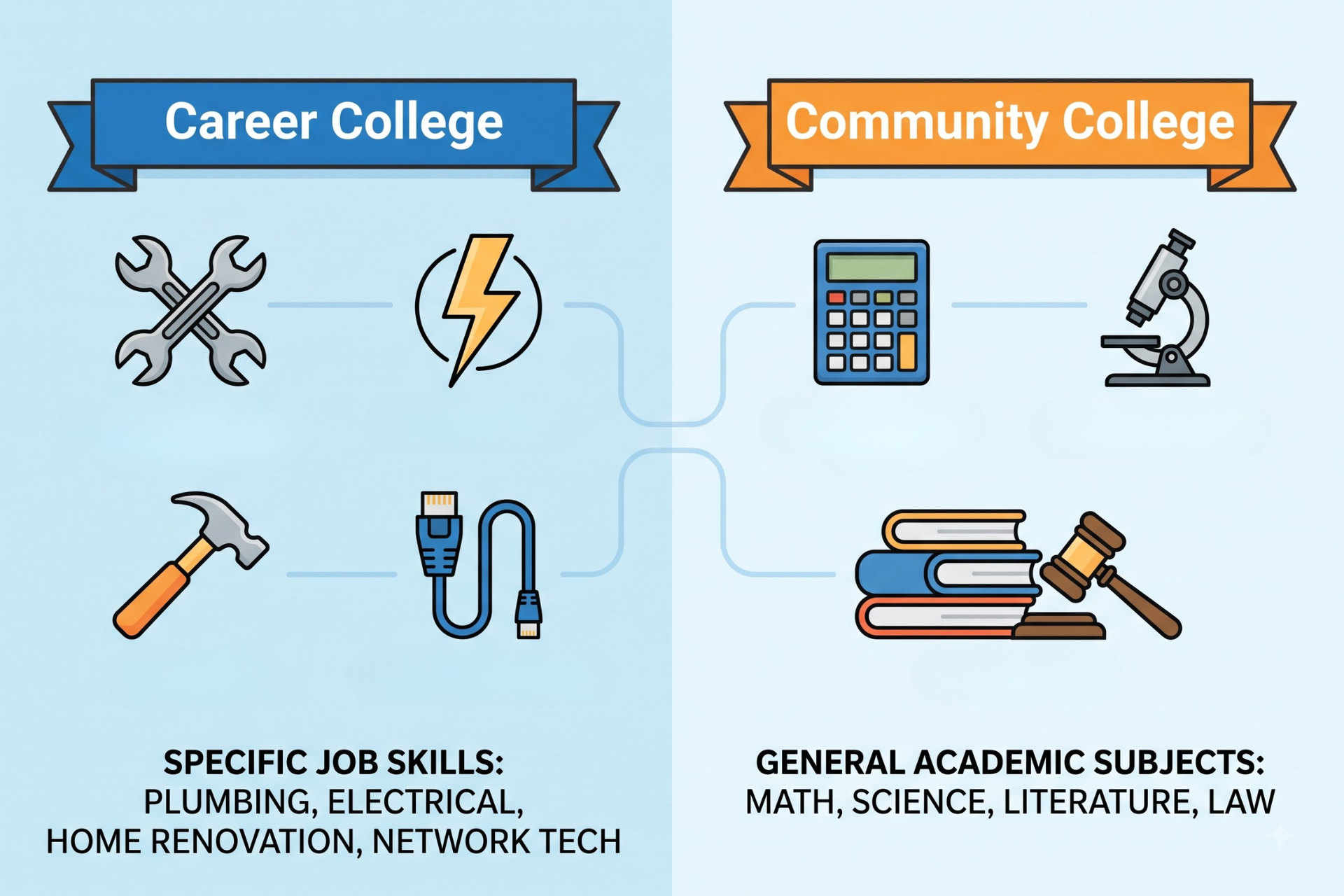
Image Source: Gemini 2026
If you already know the occupation you want, a career college can get you there faster. If you're still exploring your career goals, a community college's broader curriculum may give you more room to figure it out.
Are you the type of person who likes to take your time to study, or do you prefer to learn job-ready skills as fast as possible?
Community college programs typically take two years to complete, and some take three years, depending on the credential. Depending on your schedule and time commitment, you can take fewer or additional classes at your own pace.
If you prefer to move quickly, career college programs usually last 6 to 12 months, and some trade school programs can be completed in as little as 3 to 9 months. These shorter programs are intensively focused on equipping students with the skills for their dream job as fast as possible. In fact, about 80% of Ontario career college graduates are employed within six months of finishing their program, with roughly 58% working in their field of study.
Your learning style has a big impact on how well you absorb and process new information, so it's worth thinking about which environment suits you.
At a community college, you'll find yourself in traditional classrooms and labs for most academic-based courses, with instructors leading lectures and assigning homework and projects. Class sizes at community colleges tend to run larger, often 30 to 50 students.
At a career college, you'll spend most of your time on applied learning, whether that's a job site, workshop, or hands-on lab. Career colleges often feature smaller class sizes of 15 to 25 students, which means more one-on-one time with instructors and more hands-on skills practice.
Post-secondary education is never free, so it's worth comparing the total cost of each path before you decide.
Ontario’s publicly funded community colleges are generally less expensive than career colleges, with domestic tuition normally ranging from $2,400 to $6,100 per year, thanks to direct government subsidies. Larger classrooms mean more students share the cost of instructors and resources, but at the trade-off of a less personalized learning experience.
Career colleges tend to charge more, with full-program tuition often ranging from $10,000 to $20,000 in Ontario. That higher price tag comes with the smaller class sizes and more involved instruction mentioned above. Financial aid in the form of grants and scholarships is also available to help limit barriers to attending a career college.
At Skilled Trades College of Canada, students have access to a variety of financial supports designed to make trades education more accessible, including the Scottie Barnes Scholarship, the UFC | STC Partnership, and the Skills Dev't Fund.
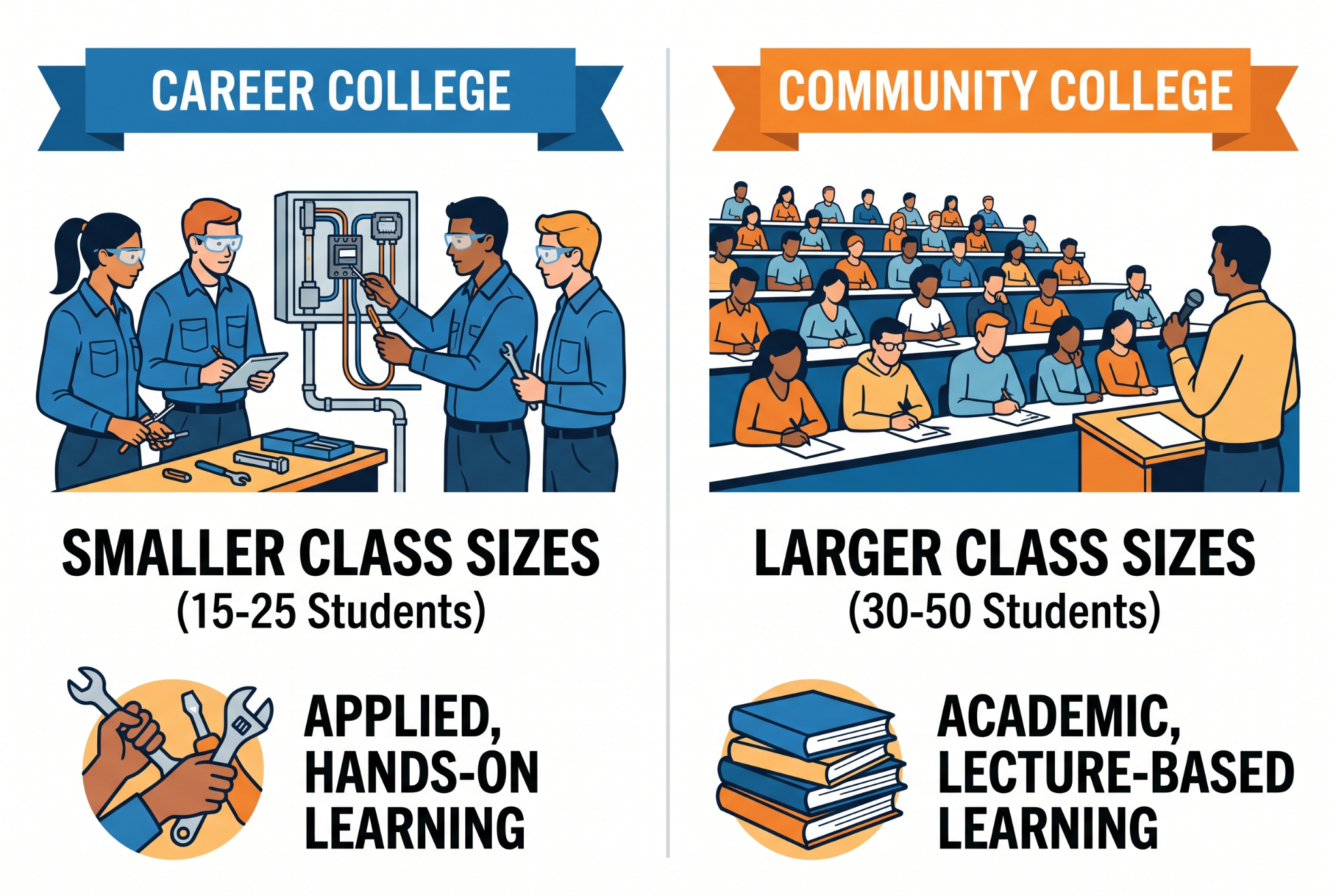
Image Source: Gemini 2026
There's no single right answer when it comes to career college vs. community college. The best choice depends on where you are in your career journey.
If you're unsure about your long-term career path, a community college can offer breathing room to explore before committing to a specific trade. If you already know you want to become a plumber, electrician, or another skilled tradesperson, a career college can get you job-ready without years of general education standing in your way.
Career colleges also tend to work well for people switching careers later in life, since the shorter time commitment fits more easily around existing responsibilities. Flexible start dates in the spring and summer, not just fall and winter, make it even easier to jump in when you're ready, whatever stage of life you're at.
Whichever path you're leaning toward, a program advisor can walk you through the registration process and answer any questions you have, so you can make an informed decision with confidence.
Community colleges offer broader academic programs over about two years, while career colleges focus on specific trades with hands-on training completed in 6 to 12 months. The right fit depends on your career goals and learning style.
A career college, also called a trade school or vocational school, is a private post-secondary institution that trains students in specific trades or occupations. In Ontario, these schools are regulated under the Ontario Career Colleges Act.
Ontario career colleges are private, regulated institutions that offer hands-on training in trades such as plumbing, electrical work, and home renovation. Skilled Trades College of Canada operates several campuses across Ontario, including Vaughan, Ajax, Mississauga, Toronto East, and Cambridge.
Many career college programs are structured as apprenticeships or pre-apprenticeships, meaning students can earn money while training. This lets you build job-ready skills and a paycheque at the same time.

Image Source: Pexels
Trades are the backbone of our economy, and choosing this career path shouldn't be viewed as a last resort. Skilled Trades College of Canada was built to raise the bar for apprentices and end the stigma around working in the trades.
If, after reading this, you've decided a career college is more your speed, Skilled Trades College of Canada is the best place to learn the skills that will accelerate your career in the trades. Each course is run by construction industry experts who know exactly what it takes to succeed, and every program follows an 80:20 ratio of hands-on training to in-classroom learning. Forget excessive tests and assignments.
Best of all, you can get job-ready in as little as 12 weeks. Don't believe us? Hear it straight from our alumni.
Book a campus tour today and see for yourself why so many students choose to build their foundation for success at Skilled Trades College of Canada.

9,281+
LIVES CHANGED
12,481+
WIRES PULLED

85,382+
2X4'S CUT

9,756+
PIPES LAYED

9,281+
LIVES CHANGED
12,481+
WIRES PULLED
85,382+
2X4'S CUT
9,756+
PIPES LAYED
9,281+
LIVES CHANGED
12,481+
WIRES PULLED
85,382+
2X4'S CUT
9,756+
PIPES LAYED


