The Risks and Rewards of Working as an Electrician
%20(1).webp)

Published On
2026-08-05

Ontario's skilled trades shortage is leaving job vacancies unfilled faster than traditional hiring can keep up, so general contractors are partnering directly with trade schools to source pre-vetted, job-ready graduates and build a reliable pipeline of skilled trades workers.
General contractors across Ontario are quietly rewriting how they hire. Instead of waiting on job board applications or hoping a foreman's cousin knows someone with a ticket, more GCs are building direct pipelines with trade schools.
It’s a response to a skilled trades shortage we’re all too familiar with at Skilled Trades College of Canada, that’s reshaping how every project gets staffed and how every employer thinks about finding skilled trades workers before a project starts, not after it stalls.
The numbers behind Ontario's labour shortage are hard to ignore. BuildForce Canada’s latest outlook projects the province will need roughly 126,100 new construction industry workers by 2035, as roughly 92,000 workers head into retirement, just to keep pace with planned infrastructure and housing demand.
Nationally, growth and retirements combined are projected to push the construction industry's overall hiring requirement to 306,200 workers by 2034, with roughly 271,900 new entrants expected and a potential shortfall of about 34,300 workers. On the residential side alone, an estimated 135,000 workers, more than a fifth of that workforce, are set to retire by 2035.
Statistics Canada data tells a similar story: skilled trades vacancies remain persistently high even as hiring in other sectors slows, and fewer young people are entering apprenticeship programs as older workers retire.
Even with an expected 98,800 new entrants expected, BuildForce still projects a shortfall of roughly 27,300 skilled workers by 2035. Immigration and credential recognition gaps only add to the mix, so the shortage won’t resolve itself through population growth alone.
Rising costs and stalled timelines are also pushing more general contractors (GCs) to factor labour shortages into their job quotes before a project ever breaks ground.
According to BuildForce Canada and Statistics Canada, electricians, plumbers, and mechanics are among the most in-demand skilled tradespeople in Ontario right now, driven by housing starts, infrastructure investment, and retirements hitting these trades hardest.
The manufacturing and industrial sectors face similar strain, competing with construction for the same pool of talent, and it’s already showing up in longer vacancies and rising costs to fill essential roles.

Image Source: Gemini 2026
Job boards, word of mouth, and union halls have carried the industry for decades, and they still have a place. But none of them were built to move at the speed demanded by today's skilled trades shortage.
Job postings attract a high volume of candidates and low certainty, since GCs have no way to verify hands-on skills before an interview. Word of mouth is limited to whoever is already in someone's network. Union halls serve their members well, but don’t keep pace with private, mixed-crew hiring.
The result is longer job vacancies, inconsistent on-site skill levels, and hiring managers spending hours filtering candidates who were never trade-ready to begin with.
Meanwhile, demand for skilled trades careers is growing, driven by strong long-term job security. More young people are choosing trades over a traditional degree than employers may realize, and many of them never connect with the GCs who need them most.
Forward-thinking contractors are solving this by building formal relationships directly with trade schools, rather than treating graduates as one more resume in the pile. The model looks less like recruiting and more like a pipeline that entirely skips traditional recruiter fees.
In this process, GCs:
It front-loads the vetting that used to happen after hire. A pre-apprentice who has already spent time on the tools, read blueprints, and trained in real-world working conditions is a fundamentally different hire from someone responding to a generic job ad.
A formal trade school partnership gives GCs four concrete advantages over ad hoc hiring: consistency in training, pre-vetted candidates, faster onboarding, and access to government funding tied to apprenticeship programs.
Consistency matters most. GCs working with a single training partner know exactly what every graduate has been taught, rather than having to guess from a patchwork of prior experience.
Candidates vetted by professional instructors reduce the screening burden on already-stretched hiring managers, and onboarding time naturally decreases, since new hires arrive with foundational skills rather than needing them built from scratch.
Many partnerships also open the door to government funding tied to apprenticeship hiring and training. Ontario's Achievement Incentive and Group Sponsorship Grant, for example, gives eligible employers up to $17,000 per apprentice as they reach training and certification milestones.
That funding can meaningfully offset the cost of building out a next generation of skilled trades workers. Our full cost breakdown of a formal hiring pipeline shows exactly where those savings appear.
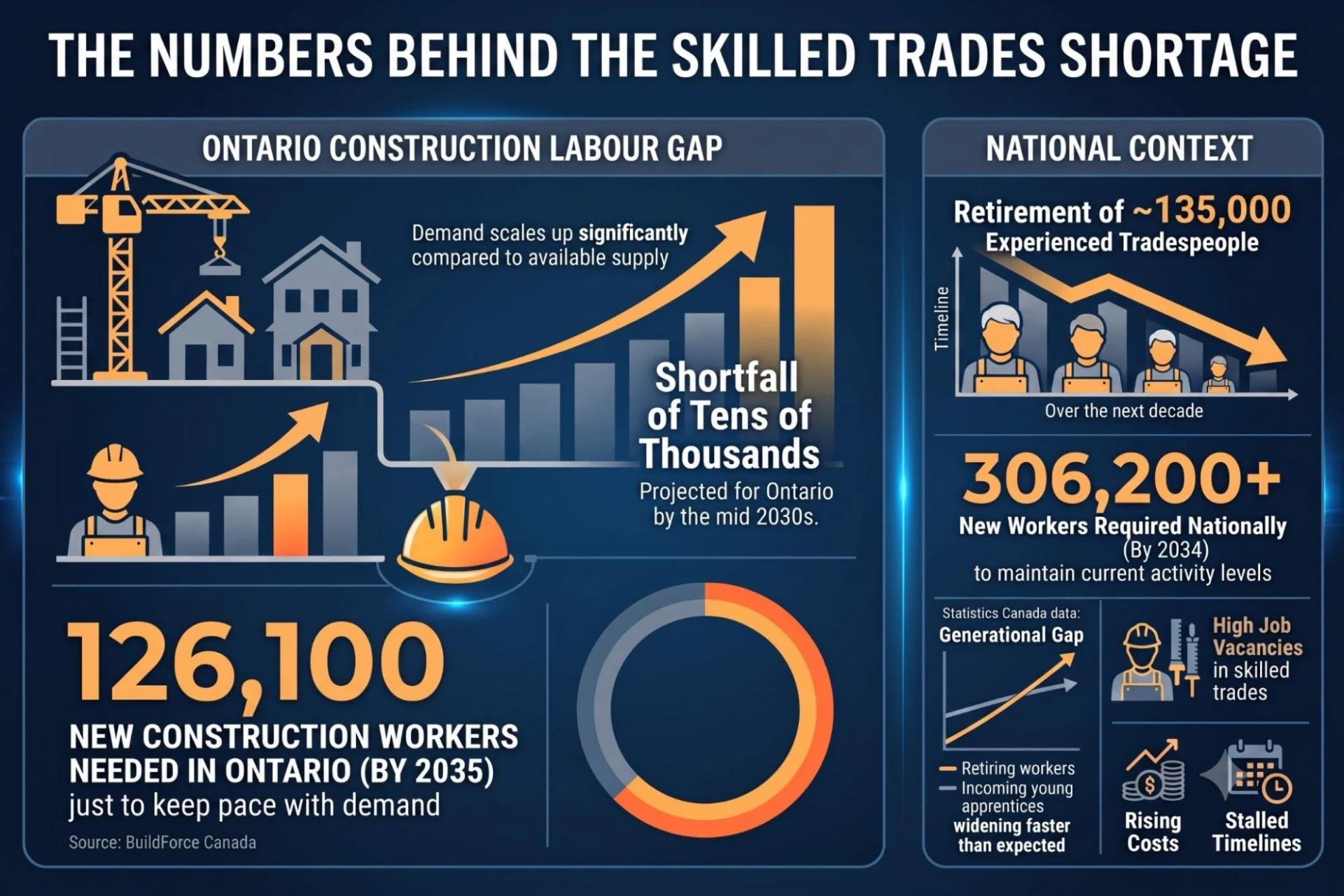
Image Source: Gemini 2026
Ontario's construction demand is not confined to one city, and neither is Skilled Trades College of Canada. With campuses in Vaughan, Ajax, Toronto East, Cambridge, Toronto West, and Oakville, GCs working across multiple regions can draw on the same training standard no matter where a project is located.
Rolling start dates in spring and summer, alongside the traditional fall and winter intakes, mean a hiring pipeline never has to pause for a semester calendar. That flexibility can be the difference between a full crew and a delayed start.
The GCs getting ahead of Ontario's skilled trades shortage are not waiting for the market to fix itself. They’re building direct lines to trained, job-ready talent before they need it.
Visit Skilled Trades College's employer page to see how the partnership process works and start building a pipeline that keeps pace with your project schedule.

9,281+
LIVES CHANGED
12,481+
WIRES PULLED

85,382+
2X4'S CUT

9,756+
PIPES LAYED
9,281+
LIVES CHANGED
12,481+
WIRES PULLED
85,382+
2X4'S CUT
9,756+
PIPES LAYED
9,281+
LIVES CHANGED
12,481+
WIRES PULLED
85,382+
2X4'S CUT
9,756+
PIPES LAYED


