What Is a Subcontractor?


Published On
2026-09-16

Apprentice job postings often require years of experience for entry-level roles designed to build it. Contractors get better results by screening for hands-on aptitude, safety certifications, and career commitment instead, widening their candidate pool to include career changers, women, and young workers.
Open almost any apprentice job posting in Ontario's construction industry, and you’ll find the same contradiction sitting near the top: "two to three years of experience required." An apprenticeship, by definition, is how a person gains experience. Asking for it as a prerequisite is like requiring someone to know how to swim before letting them take swimming lessons.
As Founder and CEO of Skilled Trades College of Canada, I’ve spent years watching this play out from both sides of the hiring table, and I think it’s time someone in this industry said the obvious thing out loud: requiring experience for entry-level trades roles is not a hiring standard.
It’s a habit, and it’s quietly shrinking the pool of good people contractors could be bringing on board.
An apprentice job description that lists years of prior experience is asking for something the role was never meant to provide in the first place. Apprenticeships exist because the trades are learned on the job, under supervision, over time. That’s how apprenticeships work in this industry, and it’s a model with a long track record of success.
So when a job posting for a first-year apprentice asks for two or three years of hands-on experience, it’s not really describing an apprentice. It’s describing someone who’s already done most of the learning an apprenticeship is supposed to deliver, and it quietly excludes the very people the position exists to develop.
This isn’t a small semantic issue. It has real consequences for who applies, who gets hired, and how deep a contractor's talent pipeline actually runs. And the timing couldn’t be worse: BuildForce Canada projects the industry's overall hiring need will climb past 306,000 workers by 2034, with a shortfall of more than 34,000 workers even after accounting for all expected new entrants.
An industry facing that kind of shortfall can’t afford to keep filtering out qualified people over a technicality.
Nobody sets out to write an impossible job posting. This pattern shows up for a few understandable reasons.
Risk aversion is probably the biggest one. Bringing on a true beginner takes time, patience, and a willingness to accept that early mistakes are part of the learning curve. For a busy contractor already stretched across multiple job sites, that can feel like a risk they can’t afford to take on.
Past hiring experiences play a role, too. Most employers in this industry have a story about a hire who didn’t work out, someone who lacked reliability or safety awareness and cost more in supervision time than they contributed in labour. It’s natural to try to mitigate that risk by demanding more experience upfront, even when experience was not actually the problem.
To be fair, not every experience line is arbitrary. Some roles genuinely require it due to insurance stipulations, union rules, or client-mandated crew ratios at a given site, and this piece does not argue against those constraints.
The habit worth challenging is the default one: the experience requirement pasted into a first-year apprentice posting purely out of caution or convention, with no contractual or regulatory reason. That’s the version quietly shrinking the candidate pool for no good reason.
There’s also the simple reality of time. Training an apprentice properly takes attention that a lean crew doesn’t always have to spare, so it feels safer to look for someone who needs less hand-holding from day one. But this is exactly where a pre-apprenticeship credential changes the equation.
A candidate who’s already completed structured training has absorbed a good portion of that time cost before they ever apply. The hand-holding a contractor is worried about has, in large part, already happened.
A lot of job postings are based on whatever the competitor down the road posted last month. If every apprentice listing in the region asks for experience, it starts to feel like the standard, even when it was never a reasoned decision in the first place.
Here’s the deeper issue. "Experience" is being used as a proxy for a handful of qualities that employers genuinely care about, but it’s a poor proxy at best.
When a contractor asks for years of experience, they usually mean someone who shows up on time, follows safety protocols without needing reminders, can handle basic tools without supervision, and actually intends to stay in the trade rather than treating it as a placeholder job.
None of those qualities requires years on a job site to develop.
If what you actually want is reliability, safety awareness, tool familiarity, and commitment, then screening for years of experience is solving for the wrong variable entirely.
If experience is the wrong filter, what should replace it? Three criteria much closer to what contractors actually mean by "experience required":
Rather than asking whether a candidate has worked a job site before, ask whether they can demonstrate basic hands-on aptitude in a controlled setting.
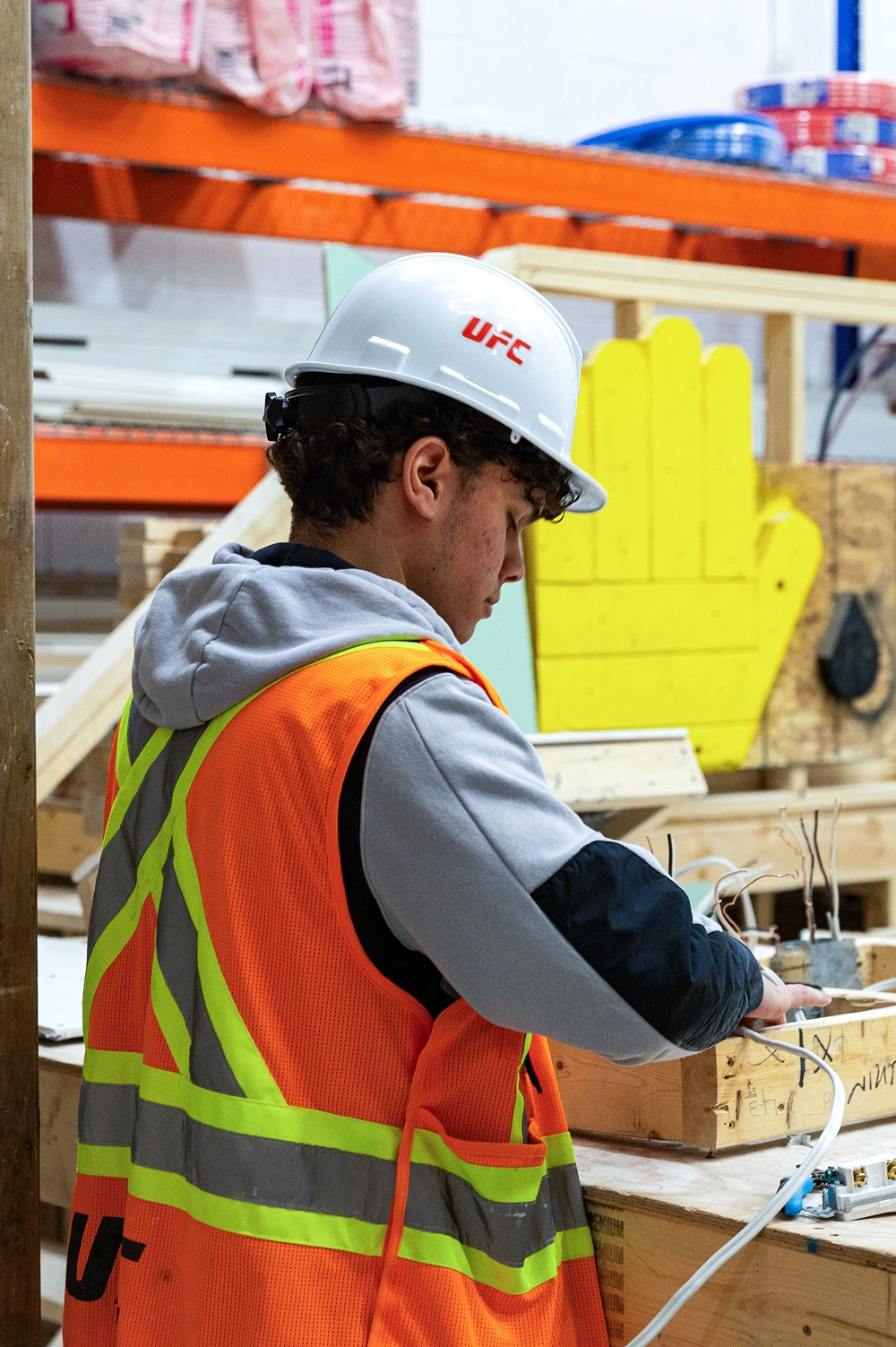
Has this person completed hands-on training in a workshop or lab environment? Can they talk through how to use core tools for the trade they’re entering? A candidate who’s spent weeks building, wiring, or assembling in a structured training program has already proven they can learn and apply a physical skill, which is what employers are trying to verify.
Safety is non-negotiable in the trades, and it’s also one of the easiest things to screen for directly rather than infer from years of experience.
Look for candidates who arrive with a documented safety certification portfolio, working at heights training, Workplace Hazardous Materials Information System (WHMIS), basic first aid, and any trade-specific safety credentials relevant to the role.
These are some of the clearest benefits of an apprenticeship-style pathway: candidates build these credentials before they ever need a job to get them.
Perhaps the most underrated signal is simply proof that someone chose this path deliberately.
Completing a pre-apprenticeship program is one of the clearest indicators available. It proves a candidate invested their own time and money into preparing for this specific career, rather than falling into a trades job by accident. That kind of intentional commitment is often a stronger predictor of retention than a resume line about a previous job.
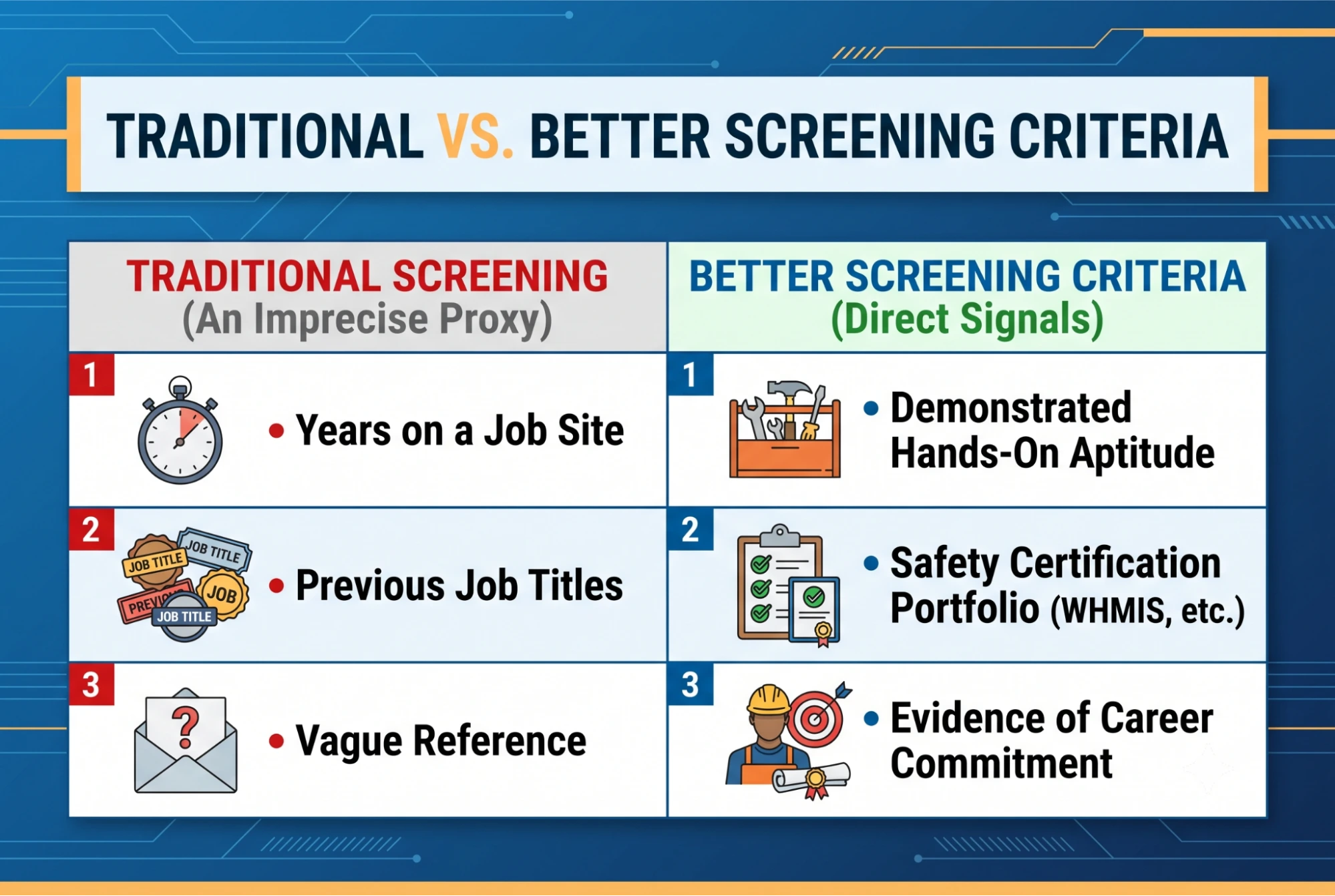
Image Source: Gemini 2026
Put these three criteria together, and the fix can be as simple as rewriting a single line on a job posting. Instead of "two to three years of experience required," try something like "completion of a recognized pre-apprenticeship program and a valid working at heights certificate."
The second version screens for the same underlying qualities, reliability, safety readiness, and commitment, without excluding every candidate who has not yet had the chance to work a paid job site.
Here’s the part that should matter most to contractors who are struggling to find good people.
Career changers, people who have spent years in another field and are looking to build something more hands-on and stable, rarely have trades experience to point to, even though they often bring an exceptional work ethic and maturity to a job site.
Women entering the trades are another group this practice disproportionately affects, and the numbers make the case on their own. Women make up 48.2% of Canada's overall workforce, yet only 14.8% of the country's Red Seal trades workforce, according to the Canadian Apprenticeship Forum's analysis of 2021 Census data.
That gap is not a reflection of a lack of interest or ability. It’s a reflection of barriers quietly filtering out capable, motivated candidates before they get a fair look.
Younger workers fall into this category, too. Someone in their late teens or early twenties who is eager, coachable, and has completed relevant training is exactly the kind of long-term hire a contractor should want, but a rigid experience line on a job posting will screen them out before they ever get the chance to prove it.
Rethinking how you screen apprentice candidates does not lower your standards. It raises the number of genuinely qualified people who make it through the door at a moment when the industry can’t afford to leave good people on the sidelines.
The trades are the backbone of our economy, and the contractors who thrive over the next decade will be those who figure out how to attract strong new talent faster than their competitors. That won’t happen by continuing to ask entry-level candidates for experience that entry-level roles were never designed to provide.
Some contractors are already solving this by partnering directly with training providers rather than waiting for experienced candidates to apply. Our trade school partnership model is one example of what that pipeline can look like when built proactively rather than reactively.
If you’re ready to connect with candidates who bring the right signals, even without years on a job site, visit Skilled Trades College of Canada's employer page to see how our graduates are prepared to contribute from day one.

9,281+
LIVES CHANGED
12,481+
WIRES PULLED

85,382+
2X4'S CUT

9,756+
PIPES LAYED
9,281+
LIVES CHANGED
12,481+
WIRES PULLED
85,382+
2X4'S CUT
9,756+
PIPES LAYED
9,281+
LIVES CHANGED
12,481+
WIRES PULLED
85,382+
2X4'S CUT
9,756+
PIPES LAYED